What can light reveal about ham maturation? HAMTRACE research presented in Siena
Researchers from Sapienza University of Rome have shared preliminary findings on a rapid, non-destructive way to characterise Prosciutto di Parma at different stages of curing, using short-wave infrared hyperspectral imaging.
Time helps shape the flavour, texture and composition of dry-cured ham. But how much can researchers learn about its maturation without removing material for laboratory testing?
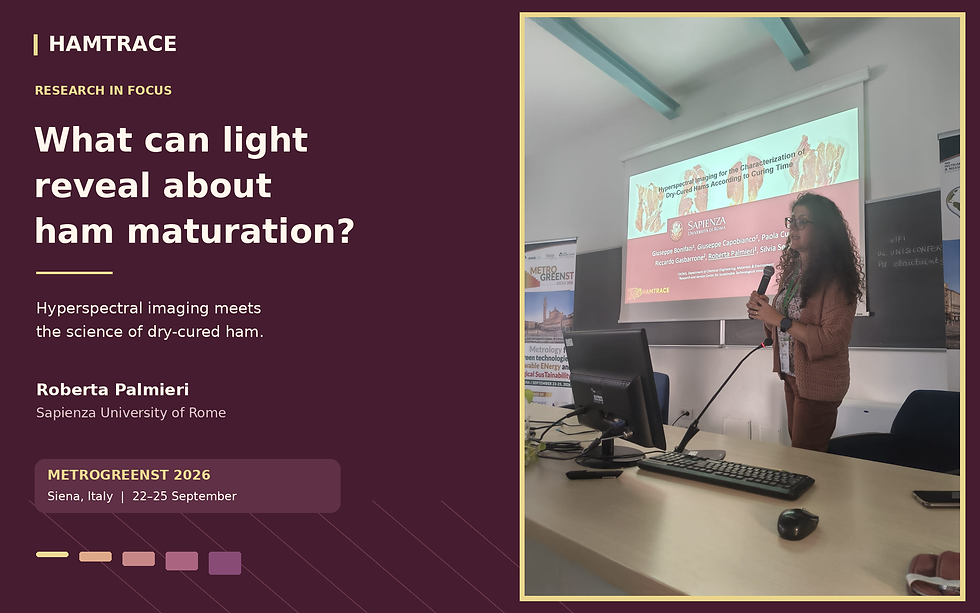
This question is at the heart of research presented by Roberta Palmieri, from HAMTRACE partner Sapienza University of Rome, at the 2026 IEEE International Workshop on Metrology for Green Technologies, Renewable Energy and Ecological Sustainability (MetroGREENST). Held in Siena, Italy, on 23–25 September 2026, the event brought together researchers and specialists working on measurement methods and sustainable technologies.
Palmieri’s oral presentation, “Hyperspectral Imaging for the Characterization of Dry-Cured Hams According to Curing Time,” shared early findings with around 50 delegates, opening discussion on how imaging could support food quality assessment.
Looking beyond what the eye can see
A conventional photograph records a product’s visible appearance. Hyperspectral imaging combines imaging with spectroscopy, collecting information across many wavelength bands. This allows researchers to investigate differences in composition that may not be apparent to the eye.
The Sapienza team used short-wave infrared (SWIR) hyperspectral imaging, covering wavelengths from 1000 to 2500 nanometres, to compare Prosciutto di Parma cured for 12 months and 24 months.
The approach offers the possibility of obtaining information quickly without destroying the sample. This could complement conventional laboratory methods, which can require destructive sampling, preparation time and associated costs.
For high-value products such as Prosciutto di Parma, understanding curing-related changes is relevant to both quality assessment and efforts to verify product claims.
What the early results show
The researchers analysed the imaging data using Principal Component Analysis (PCA), a statistical method that helps identify the main patterns and differences within complex datasets.
The preliminary results indicated that fat and lean tissue could be clearly distinguished through their spectral “fingerprints” — the characteristic ways they interact with light. Both tissue types also showed spectral differences associated with curing time, suggesting changes in their physical and chemical characteristics during maturation.
These observations provide a starting point for further investigation. The dataset remains limited, and the findings do not yet support definitive classification by curing time. The work is therefore an initial assessment of the technique’s potential, rather than a validated method for verifying a ham’s age.
From promising patterns to practical tools
The next stage will examine larger sample sets from different origins, including Italian and Spanish hams. Expanding the dataset will help researchers assess whether the patterns observed remain consistent across a wider range of products.
The team also plans to develop supervised classification models, including Partial Least Squares Discriminant Analysis (PLS-DA) and machine-learning approaches. These methods learn from samples with known characteristics, with the aim of classifying new samples.
The longer-term ambition is to evaluate whether hyperspectral imaging can support automated checks of authenticity and curing age. This connects with HAMTRACE’s wider work to strengthen authentication and traceability across dry-cured ham value chains.
Sharing findings and testing ideas
The Siena workshop provided an opportunity to discuss the research with specialists in metrology — the science of measurement — alongside researchers developing sustainable technologies and innovative analytical approaches.
For Palmieri and the Sapienza team, presenting the work offered a chance to gather feedback, exchange knowledge and explore scientific collaboration. Such discussions are useful as the research moves from identifying early patterns towards establishing how reliably they can be measured and interpreted.
You can access the full presentation here.
The study was carried out by Giuseppe Bonifazi, Giuseppe Capobianco, Paola Cucuzza, Roberta Palmieri and Silvia Serranti, from Sapienza’s Department of Chemical Engineering, Materials & Environment (DICMA), together with Riccardo Gasbarrone, from the Research and Service Center for Sustainable Technological Innovation.
About HAMTRACE
HAMTRACE — Advancing European Dry Cured Ham Value Chains with Data-Driven Authentication and Global Traceability Standards — is a Marie Skłodowska-Curie Actions Staff Exchanges project.
It brings together ten organisations from Spain, Montenegro, Italy, France, Serbia and the United Kingdom to help protect dry-cured hams from fraud and support producers in demonstrating their products’ origin and quality.
Find out more about the event on the MetroGREENST conference website. https://metrogreenst.org/
Funded by the European Union under Grant Agreement No 101236645. Views and opinions expressed are however those of the author(s) only and do not necessarily reflect those of the European Union. Neither the European Union nor the granting authority can be held responsible for them.
Comments