From Novi Sad to Podgorica: HAMTRACE secondments bring AI, smart-tag and business expertise together
Four specialists from HAMTRACE partner DunavNET travelled from Serbia to Montenegro for a series of research exchanges, bringing expertise in connected technologies, artificial intelligence, software engineering and business development to the project's work on digital traceability of dry-cured ham.
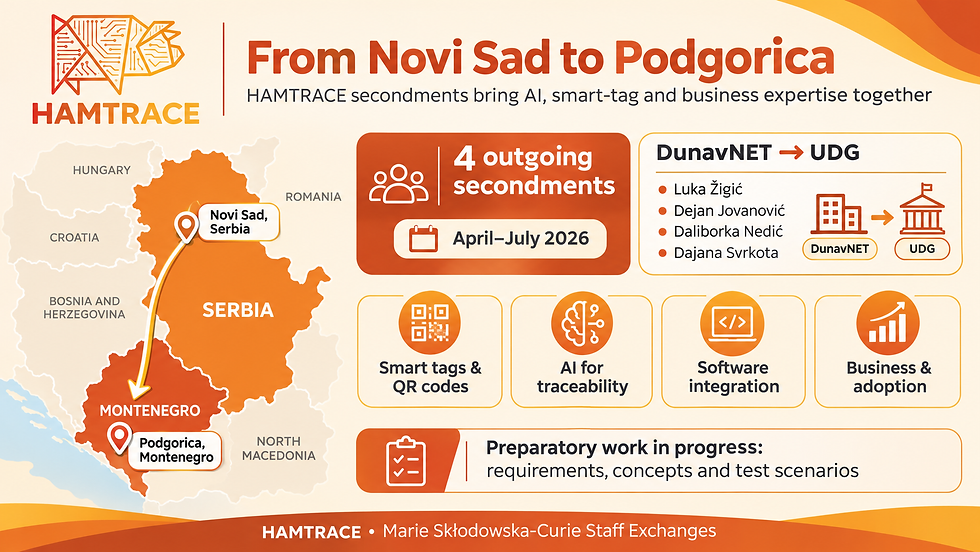
Between April and July 2026, four staff members from DunavNET, based in Novi Sad, Serbia, completed individual secondments of approximately one month at the University of Donja Gorica (UDG) in Podgorica, Montenegro.
The exchanges brought together researchers, technical specialists and business experts to explore how blockchain technology, smart tags, QR codes and artificial intelligence could contribute to more secure and transparent traceability of dry-cured ham.
The secondments form part of HAMTRACE's Marie Skłodowska-Curie Staff Exchanges programme, which supports international and cross-sectoral collaboration through the exchange of knowledge, skills and expertise.
Bringing different expertise to a shared challenge
The four DunavNET secondees contributed complementary skills:
Luka Žigić, specialising in IoT devices and connected systems, explored the technical requirements for smart-tag and QR-code integration.
Dejan Jovanović, Senior Software Engineer, contributed expertise in software architecture and the connections between digital traceability components.
Daliborka Nedić, Senior Software Developer and AI/ML Team Lead, focused on opportunities for integrating artificial intelligence into traceability services.
Dajana Svrkota, Finance Manager, contributed to discussions on business feasibility, economic incentives and the practical adoption of traceability technologies.
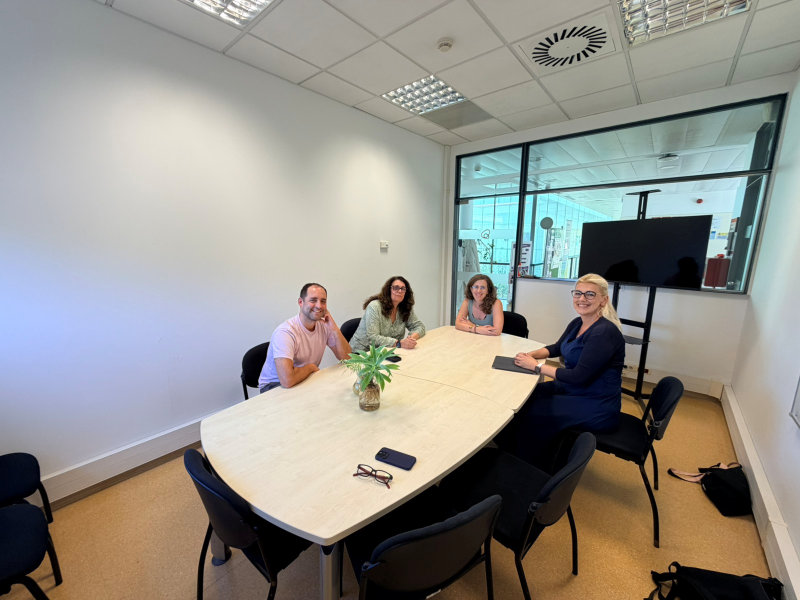
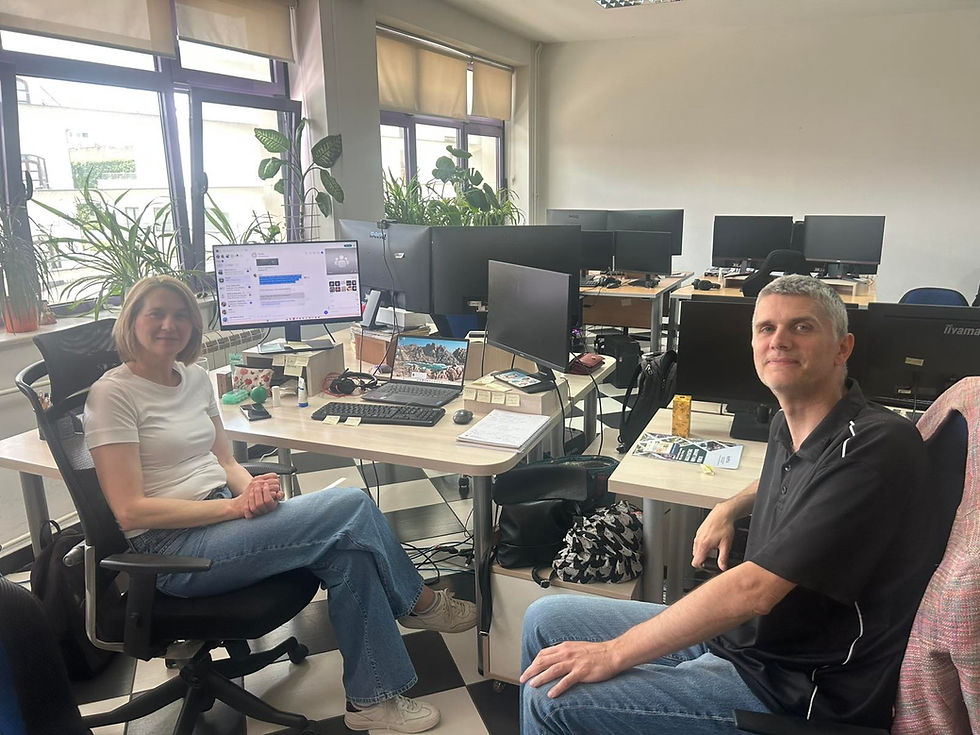
Working alongside UDG's research and technical teams, the secondees participated in technical meetings, workshops, visits to research facilities and discussions with stakeholders from the regional dry-cured ham sector.
Connecting smart tags, blockchain and AI
A major focus of the exchanges was exploring how the different digital components being developed within HAMTRACE could work together.
The teams examined requirements for dynamic QR codes and smart tagging, alongside the middleware and application programming interfaces (APIs) needed to connect physical product tags with blockchain records and cloud-based data repositories.
They also prepared preliminary testing protocols and simulation scenarios to investigate QR-code scanning and data integrity.
Artificial intelligence was another important area of collaboration. The teams explored requirements for future AI-supported services, including anomaly detection, data-quality assessment and explainable AI, as well as initial concepts for multimodal interfaces.
These activities represent preparatory steps towards an integrated digital traceability solution, rather than completed or deployed technologies.
Making traceability practical for the food sector
Developing reliable digital tools is only part of the challenge. For traceability systems to succeed, they must also meet the needs of the businesses and organisations expected to use them.
The secondments therefore considered the economic and practical aspects of introducing new traceability technologies into dry-cured ham supply chains.
Discussions with UDG researchers and regional stakeholders explored the needs of producers, certification bodies and consumers, including potential economic incentives, training requirements and barriers to adoption.
This work provided preliminary inputs for HAMTRACE's exploitation planning, cost-benefit considerations and the development of value propositions for its future solutions.
Knowledge exchange in both directions
The secondments were also an opportunity to share expertise between the two organisations.
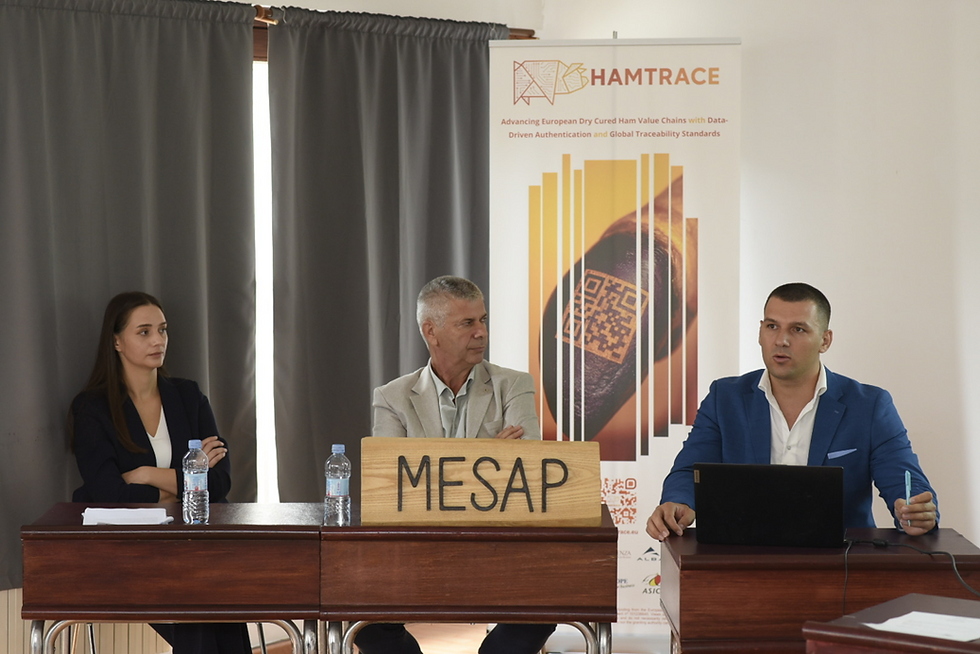
DunavNET staff led joint technical sessions at UDG on AI tool integration and cloud platform architecture, while also contributing experience in financial management, EU project implementation and business feasibility assessment.
Following the exchanges, the knowledge gained was shared with DunavNET's WP4 and WP5 teams through an internal workshop and briefing.
Reflecting on her experience, Daliborka Nedić, Senior Software Developer and AI/ML Team Lead at DunavNET, said:
"It provided an excellent opportunity to exchange ideas, learn about different approaches, and strengthen collaboration with colleagues from another institution."
The collaboration also extends in the opposite direction, with DunavNET hosting HAMTRACE researchers from UDG and France as part of the project's wider programme of staff exchanges.
Next steps towards integrated traceability
The next stage of the collaboration will focus on finalising specifications for data exchange between the blockchain and smart-tag components and the wider HAMTRACE system.
Further technical exchanges have also been recommended ahead of joint hands-on testing of the integrated pilot software.
By combining expertise in connected technologies, artificial intelligence, software development and business adoption, the exchanges are helping establish the technical and practical foundations for HAMTRACE's future traceability solutions.
Further information
Read about the complementary staff exchanges from UDG to DunavNET in our earlier article:
HAMTRACE has received funding from the European Union's Horizon Europe research and innovation programme under the Marie Skłodowska-Curie Staff Exchanges grant agreement No 101236645.
Comments