Montenegrin ham producer MARTEX and EU project HAMTRACE join forces to open doors to international markets
Researchers from the Universitat Autònoma de Barcelona and the University of Donja Gorica met the Cetinje-based producer to present the project, review the local and international ham market and agree how Montenegro's case will be built into the research

HAMTRACE partners from UAB and UDG with MARTEX representatives in front of the MARTEX facility in Bajice, Cetinje, 1 October 2026. Photo: HAMTRACE.
Cetinje, October, 2026. Representatives of the Universitat Autònoma de Barcelona (UAB), coordinator of the Horizon Europe project HAMTRACE, and of the University of Donja Gorica (UDG) visited MARTEX, one of Montenegro's best-known producers of dry-cured pork products, to present the project and explore how the company can take part in it. The meeting was also attended by the Montenegrin Pršut Cluster, which brings together leading ham producers from Cetinje.
HAMTRACE (Advancing European Dry Cured Ham Value Chains with Data-Driven Authentication and Global Traceability Standards) is a four-year Marie Skłodowska-Curie Actions Staff Exchange project funded by the European Union. Ten organisations from Spain, Montenegro, Italy, France, Serbia and the United Kingdom work together to protect dry-cured hams from fraud and to help producers prove the origin and quality of their products, using chemical fingerprinting and blockchain-based traceability.
Montenegro's case study The visit focused on Work Package 1, which builds the chemical and production baseline for dry-cured hams in each partner region. The team explained what the Montenegrin case study needs: information on how and where the pigs are raised, the curing and ageing process, and the traceability data a producer already holds. MARTEX, which has produced at its Bajice facility near Cetinje since 1996 and has worked under an HACCP quality system since 2005, is an ideal reference for how Montenegrin pršut is made today.
From local tradition to international markets The two sides discussed the state of the ham market in Montenegro and abroad, the growing demand for products with a verifiable origin, and MARTEX's interest in growing its international presence. Selling abroad usually requires more than a good product: buyers and authorities expect certification, documented origin and consistent quality. HAMTRACE is designed to give producers such tools.
MARTEX confirmed its interest in contributing to the research, including the supply of ham samples for the project's laboratory analyses in Work Package 2, where elemental fingerprinting methods are being developed to distinguish hams by origin.

HAMTRACE partners, MARTEX and the Montenegrin Pršut Cluster discussing the Montenegrin case study, Cetinje, 1 October 2026. Photo: HAMTRACE.
"Montenegro brings to HAMTRACE a ham-making tradition that deserves to be known and protected beyond our borders. Through this project, Montenegrin producers gain direct access to European research partners and certification expertise, and we at UDG are glad to connect them," commented Prof. Tomo Popović, local coordinator of HAMTRACE at the University of Donja Gorica.
"Getting to know the goals of HAMTRACE, we see a real opportunity to use the project's results to improve our business and to prove the origin and quality of our ham (pršut). Verifiable traceability and certification could also be what opens the door to the EU market for us," said Maja Šaranović, wholesale director at MARTEX.
"Montenegrin pršut has a long tradition, but tradition alone is no longer enough to compete abroad. HAMTRACE brings our producers knowledge and tools for authentication and traceability that can improve how we work and, in time, help Montenegrin producers open up to the EU market. That is our goal," added Ilija Ševaljević, secretary of the Montenegrin Pršut Cluster (Klaster Crnogorski pršut).
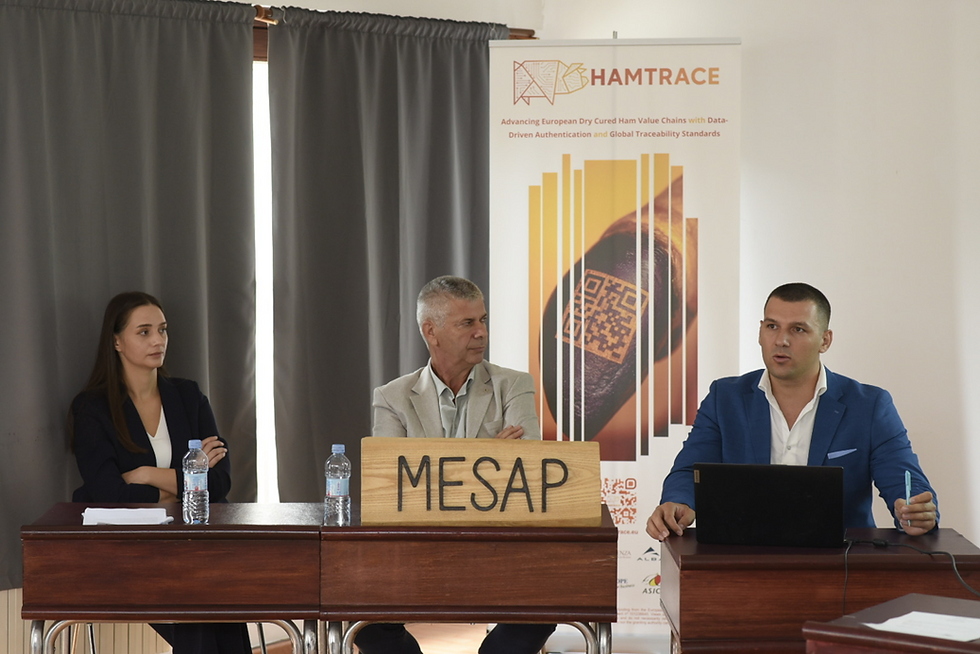
Next step: a joint visit in Cetinje in September 2027. The partners agreed to explore a follow-up visit in September, timed with the annual International Ham Fair in Cetinje (MESAP) mid-September, and to invite other consortium partners. One of them is ASICI, the Spanish association with long experience in quality certification of cured pork, whose know-how matches MARTEX's need for international certification. Other Montenegrin producers will be welcome to join the discussion.
"Montenegrin ham producers who want to learn more about the project or take part are welcome to contact us," added Prof. Manuel Valiente from UAB, Coordinator of HAMTRACE project.
About HAMTRACE
HAMTRACE is coordinated by UAB (Spain) and includes UAB, University of Donja Gorica (Montenegro), Sapienza University of Rome (Italy), ALBA Synchrotron (Spain), CETI (Montenegro), ADERA/UT2A (France), DunavNET (Serbia), Europe for Business (UK), ASICI (Spain) and Food Hub (Italy).
About MARTEX
MARTEX Ltd. was founded in Cetinje in 1992 by Marko Martinović, started wholesale activity in 1994 and opened its drying facility in Bajice in 1996. It makes prosciutto, smoked ham, cured neck, pancetta, sausages and other dry-cured products and sells them through its own shops in Cetinje and Budva. Website: https://martex.co.me/en/
About the Montenegrin Pršut Cluster
The Montenegrin Pršut Cluster (Klaster Crnogorski pršut) is an association of ham producers founded in Cetinje in 2017. Its members are established family companies from Cetinje, including Zrnožit, MARTEX, Interprodukt, Mianja, Gornič and Montestate. “Crnogorski pršut” was entered in Montenegro’s register of geographical indications in 2018, and the cluster is now preparing for EU certification so that the product can obtain a protected European designation. The cluster initiated and co-organises MESAP, the International Ham Fair in Cetinje, whose fifth edition took place on 18–19 September 2026.
Media contact: Lesley Tobin, lesley@e4business.eu; HAMTRACE Communication Team
Funded by the European Union (Grant Agreement No 101236645). Views and opinions expressed are however those of the author(s) only and do not necessarily reflect those of the European Union or the European Health and Digital Executive Agency (HADEA). Neither the European Union nor the granting authority can be held responsible for them

Comments